The NBA is a closed franchise competition
NBA teams hold places as franchises rather than earning promotion from a lower division. Poor results do not send a franchise down to the NBA G League, and winning in the G League does not create an NBA place. The regular season establishes positions for the postseason, with championship play-offs organised through the league's conference structure.
The NBA also operates a cup competition within its wider calendar. Its regulations determine which games count towards regular-season records and how teams advance. The central distinction remains that the league controls an integrated competition environment. A franchise does not simultaneously enter a separate national league in the way that a European club can.
European clubs have domestic schedules
Spain's Liga ACB, Germany's Basketball Bundesliga and Italy's Lega Basket Serie A are examples of national top-division structures. Each has its own regulations for league play, postseason qualification and club participation. Promotion and relegation exist in many European domestic systems, but administrative, financial and licensing conditions can also affect movement between divisions.
A national cup is a separate competition, even when entry depends on league position. Spain's Copa del Rey illustrates why two meetings between the same clubs may carry different consequences. One can affect a league table; another can end a cup campaign. The competition label is therefore essential context for understanding a result.
Continental basketball is not one open pyramid
EuroLeague and EuroCup are organised by Euroleague Basketball. The Basketball Champions League sits within a separate FIBA-linked structure. These competitions should not be read as a simple equivalent of consecutive domestic divisions. Entry arrangements, licences, invitations and sporting criteria differ, and regulations can change without altering the basic distinction between the organisers.
Winning a domestic championship does not universally guarantee a EuroLeague place. Conversely, a club's continental participation does not replace its domestic obligations. A team may have one standing in its national league and another in a cross-border competition, against different opponents. Results in one table should not be added to the other.
The route to a title changes the stakes
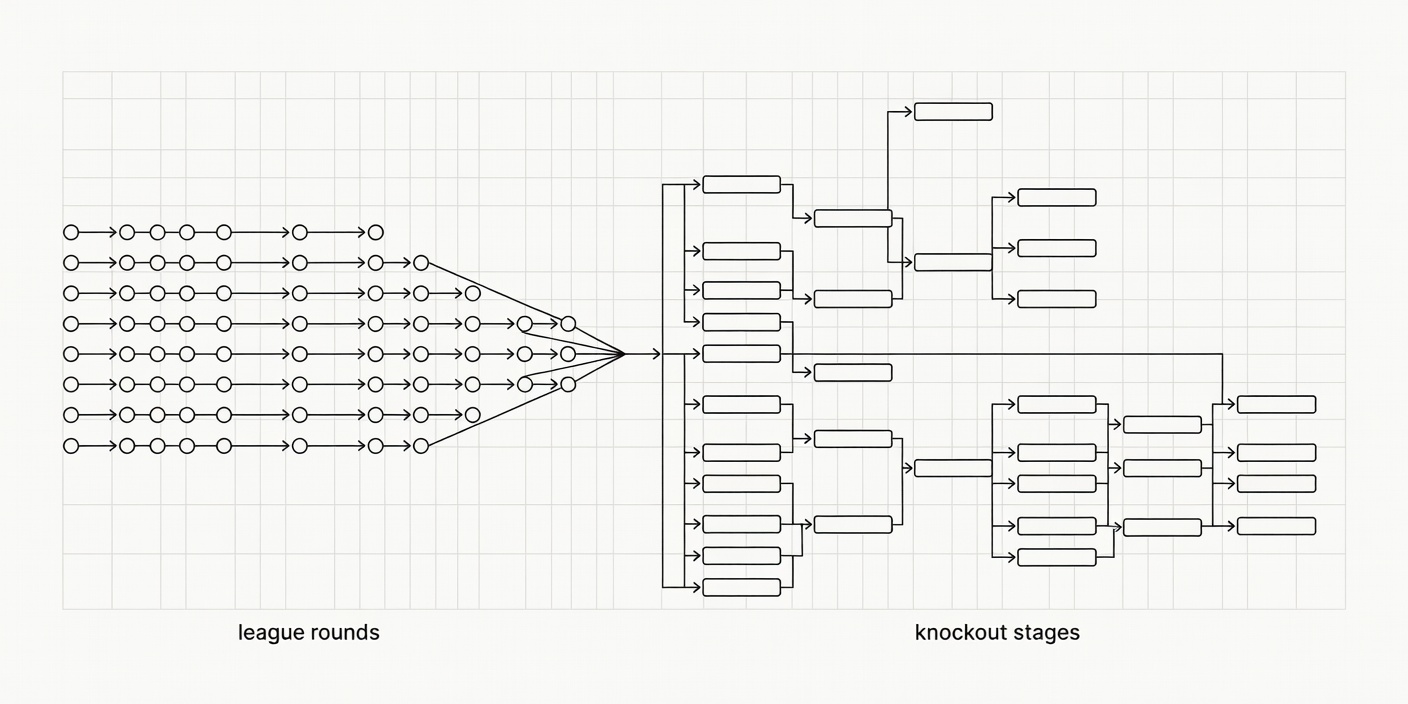
A league table rewards results across repeated fixtures, while a knockout game concentrates the consequence in one contest. A play-off series sits between those mechanisms: opponents can adjust over several meetings, but defeat still ends the campaign. NBA championship rounds use series; EuroLeague has used a Final Four to decide its closing stage after earlier qualification rounds.
Those structures influence how a result is interpreted. A narrow loss in a long regular season is not equivalent to the same loss in a single-game semi-final. Before comparing pressure or consistency, identify the stage, the advancement rule and whether another meeting is guaranteed. Consult the organiser for the applicable format rather than assuming every edition is identical.
Roster regulation follows different systems
The NBA's collective bargaining agreement governs mechanisms including its salary-cap system, draft and player contracts. European clubs operate under domestic law, federation requirements and competition regulations, rather than one continent-wide labour agreement. Domestic rules concerning locally developed players or foreign-player eligibility can differ from the rules governing a club's continental matches.
This helps explain why comparisons based only on team spending can be misleading. The scope of a reported budget may include different activities, and player-cost rules are not interchangeable. A useful structural comparison identifies who sets the roster rules and which competition they apply to, without treating an unqualified budget figure as a measure of competitive balance.
College and national teams are separate branches
NCAA basketball belongs to educational institutions and has its own conferences and national tournaments. It is a significant development setting, but it is not an NBA second division. International national-team events, including FIBA competitions and Olympic basketball, are another branch again: eligibility is based on national-team rules rather than club membership.
Following a European club alongside an NBA franchise is easier when each fixture is labelled by organiser, stage and consequence. The watching guide covers schedules and box scores, while the player pathways guide explains how athletes move between systems that are connected by recruitment rather than one shared league ladder.
Competition references
Find format and participation details through the NBA, Euroleague Basketball, Basketball Champions League and ACB. These organisers publish the regulations needed to interpret a particular fixture or qualification route.