The comparison starts with the rulebook
The NBA has its own playing rules. FIBA's rules provide the principal reference for international basketball and much European club competition, with competition-specific regulations covering matters such as administration and replay arrangements. NCAA basketball follows a separate rulebook. A college game is therefore not a smaller version of an NBA game for rules purposes, and a European domestic fixture should be checked against its organiser's regulations.
The differences below concern men's NBA basketball and the standard FIBA game. They explain several visible changes when switching broadcasts: how much time remains, where help defenders can stand and when a player must leave after accumulating fouls. They are not a complete officiating manual.
Game length and the shot clock
NBA regulation consists of four 12-minute quarters; FIBA regulation has four 10-minute quarters. Both use a 24-second shot clock and five-minute overtime periods. Both also use a 14-second reset in specified situations, including an offensive rebound after the ball touches the ring. The exact reset depends on the event and where play resumes, so not every interruption produces the same clock setting.
The extra eight regulation minutes make raw points-per-game comparisons incomplete. A higher final score may reflect more playing time rather than faster possessions or more efficient shooting. Per-possession statistics are more useful for separating those effects, although their calculation should still be checked.
| Rule | NBA | FIBA |
|---|---|---|
| Regulation quarter | 12 minutes | 10 minutes |
| Playing court | 94 × 50 feet | 28 × 15 metres |
| Personal-foul limit | Six | Five |
| Defensive three seconds | Applies, with exceptions | No equivalent restriction |
Court size and the three-point line
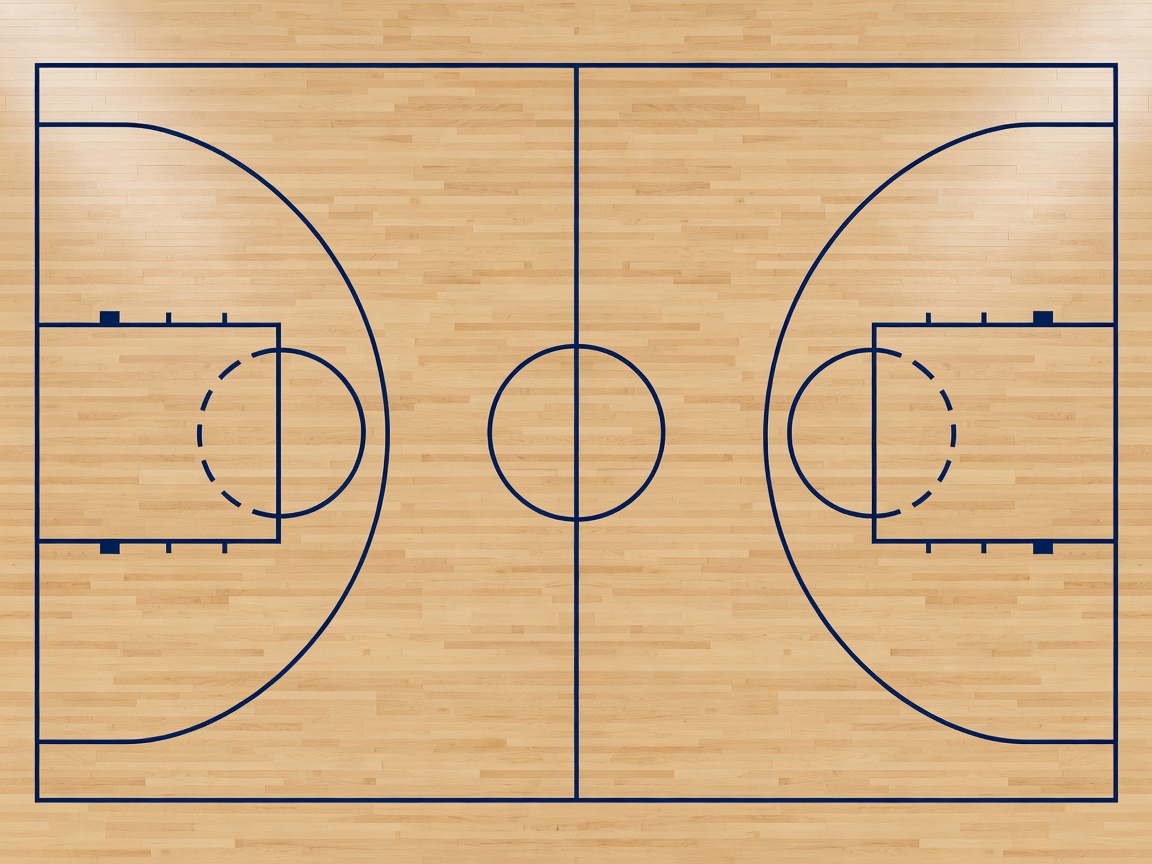
The NBA's 94-by-50-foot court is approximately 28.65 by 15.24 metres, slightly larger than FIBA's 28-by-15-metre court. The NBA three-point arc is 23 feet 9 inches from the basket centre, shortening to 22 feet in the corners. FIBA uses a 6.75-metre arc with straight corner sections. These measurements come from the respective court diagrams, not from an estimate of television pictures.
A deeper arc can stretch defenders further from the basket. It does not automatically produce better spacing: the shooting threat of the players and their positions still determine whether defenders follow them. The corner geometry also matters because a small change in available floor space affects passing angles and help rotations.
Defending the paint
NBA defensive three seconds restricts how long a defender can remain in the lane without actively guarding an opponent, subject to the rule's exceptions. FIBA has no corresponding defensive three-second rule. Both codes restrict an offensive player's time in the lane under specified conditions. Confusing the offensive and defensive rules can make an otherwise legal defensive position appear prohibited.
Under FIBA rules, a centre can occupy a position nearer the basket without having to satisfy the NBA's active-guarding requirement. That can influence a driving player's route and the timing of a pass. It does not mean European teams always defend in a zone, or that NBA teams cannot protect the paint.
The rim, held balls and foul trouble
Under FIBA rules, a ball that has touched the ring can generally be played above it, provided other interference restrictions are not breached. NBA basket-interference rules protect the imaginary cylinder above the ring. In both systems, other goaltending and interference provisions still apply; the FIBA difference is not permission to touch any descending shot or shake the basket.
FIBA uses alternating possession for many held-ball situations after the opening jump ball. The NBA uses jump balls in corresponding situations. A player's foul limit also differs: five under FIBA rules and six in the NBA. Coaches must therefore manage foul trouble within different regulation lengths, rather than treating the extra NBA foul as an isolated advantage.
Rule sources
Consult the NBA official rulebook for court dimensions, timing, fouls and defensive three seconds, and FIBA's official documents for playing rules, court diagrams and interpretations. Competition regulations should be checked for replay procedures and other event-specific provisions. The tactical comparison explains how these conditions can affect possessions.