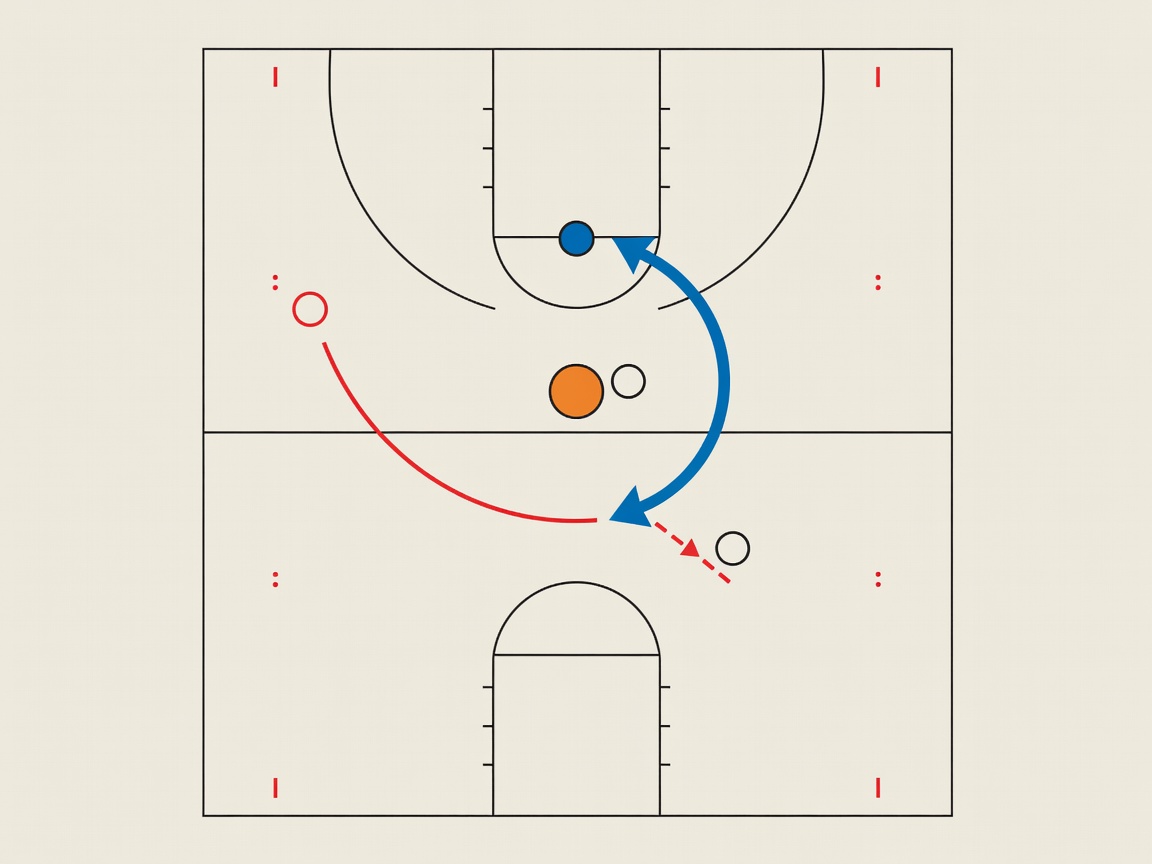
Spacing depends on who must be guarded
The NBA's longer three-point arc creates a different starting geometry from a FIBA court. A defender following a credible shooter can be drawn further from the basket, increasing the distance required to help and recover. However, a player standing far away does not create useful space if the defence is willing to leave that player unguarded. Shooting ability and passing decisions matter alongside the painted lines.
European teams can also play with all five attackers outside the lane, while NBA teams can use line-ups with limited perimeter shooting. “Five-out” describes positioning, not a continent or a guarantee of an open drive. Watch whether the weak-side defender stays attached to a shooter or moves towards the ball.
The pick-and-roll is shared territory
A pick-and-roll begins with a screen for the ball-handler and a subsequent movement by the screener towards the basket. The screener may instead move into shooting space, producing a pick-and-pop. Both actions are common tools in NBA and European club basketball. Their purpose is to force defenders to coordinate while creating a passing, shooting or driving advantage.
Defences can switch assignments, keep the big defender deeper in drop coverage, or bring that defender towards the ball. Each choice concedes something. A switch can create a size mismatch; a drop can allow a pull-up shot; a more aggressive response can open a short pass behind the pressure. The important question is which concession the attacking players can exploit.
Help defence changes the driving route
FIBA's absence of an NBA-style defensive three-second restriction permits a defender to remain near the basket without the same active-guarding requirement. This can place an additional obstacle in a driver's path. An attacking team may respond with a shooting centre, a cut behind the helper or a pass that moves the defence before the drive begins.
The NBA restriction does not remove help defence. Defenders can move in and out of the lane, guard nearby opponents and rotate when the ball arrives. Counting visible bodies in the paint is therefore not enough to judge legality or difficulty. The timing of the help and the next pass often explains the possession more clearly.
Ball movement and isolation can coexist
An isolation gives a ball-handler space to attack a defender directly. It may follow several screens designed to secure a favourable match-up. A possession that ends with one player dribbling is not necessarily unplanned, just as a sequence of passes is not necessarily effective. Movement has value when it changes the defence or improves the eventual shot.
EuroLeague clubs such as Real Madrid, Olympiacos and Fenerbahçe operate within the same broad competition environment, but a club name does not identify one permanent system. The same applies to NBA franchises such as the Boston Celtics and Denver Nuggets. Coaching changes, available players and opponents can alter the balance between post play, screening, cutting and isolation.
Pace is not the final score
Pace describes the frequency of possessions, usually expressed using a defined game-length basis. Offensive efficiency concerns points produced per possession. The NBA's longer regulation game affects totals before any stylistic difference is considered. A EuroLeague game with a lower score can still contain quick decisions, while a high-scoring NBA game can include extended half-court possessions.
Transition also has degrees. A team may seek an immediate lay-up, an early three-pointer or a quick ball screen before the defence is organised. If those options disappear, it can move into a set offence. To compare pace, use statistics with matching definitions and separate regulation from overtime rather than relying on the impression left by highlights.
What to follow during a possession
Start with the screen defender, then follow the defender furthest from the ball. Their movements reveal the first coverage and the help behind it. After a pass, note whether the advantage survives: the receiver may shoot, drive against a moving defender or return the ball because the defence has recovered. This sequence works as a viewing approach in both competitions.
Differences between two particular teams can exceed the differences suggested by a league label. Compare similar situations—half-court against half-court, or late-clock against late-clock—and keep the rule differences in view. That provides a more reliable explanation than assigning athleticism to one continent and tactical awareness to the other.
Further reference
The Jr. NBA and FIBA's World Association of Basketball Coaches resources explain shared coaching concepts. Official NBA statistics and EuroLeague competition information provide starting points for comparing defined game data.